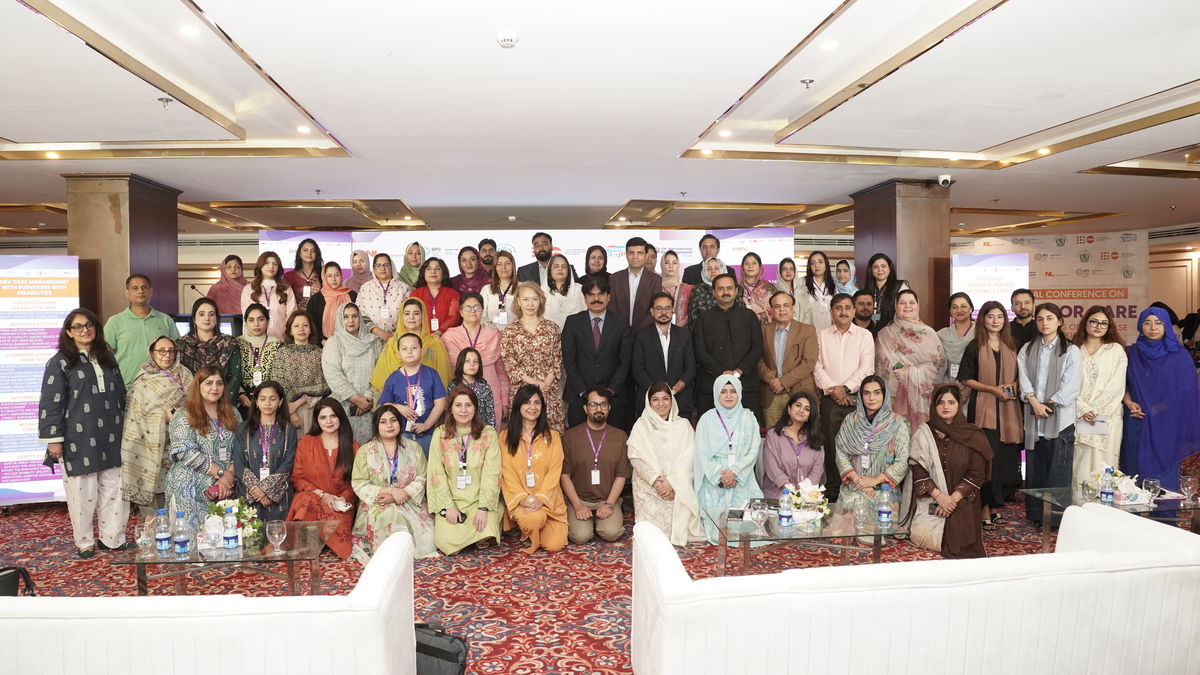
The Two-Day National Conference “Connected for Care,” convened in Islamabad Best Western Hotel by Ministry of Human Rights with the technical support from Strengthening Participatory Organization (SPO) and UNFPA Pakistan and the generous funding from the development partners the Foreign, Commonwealth and Development Office (FCDO), and the Embassy of the Netherlands, concluded in Islamabad on 23 June 2026. The first day had set a clear mandate: high-level speakers from the Ministry of Human Rights, UNFPA Pakistan, and SPO established that nearly one in three ever-married women in Pakistan has experienced violence, that critical gaps in investigation and case processing continue to deny survivors justice, and that coordinated, survivor-centred GBV case management is a national imperative. Provincial poster presentations by certified trainers from all five regions surfaced shared barriers: weak referral coordination, social stigma, and inadequate supervision alongside promising field practices. The second day translated this into institutional commitments.
Ms. Mehreen Jaswal, Consultant, UNFPA Pakistan, facilitated a session on GBV case management for married and adolescent girls, drawing on regional findings that exposed a critical service gap. Married girls, she noted, are systematically excluded from both GBV services and child protection frameworks, fall through the cracks of an uncoordinated system, and rarely access help until years into a cycle of violence or at a point of severe crisis. She called for a bridged approach that proactively informs married girls of available services by ensuring the survivor-centered principles. She also stressed that without addressing economic dependency, legal contradictions, and normalized child marriage patterns in Pakistan, GBV case management alone cannot deliver lasting protection.
Following this, A panel discussion moderated by Ms. Mahjabeen Qazi, Head of KP Office, UNFPA Pakistan, examined how GBV case management competencies can be institutionalized within universities, academia and professional training institutions so that graduates enter the workforce practice-ready. Punjab and Khyber Pakhtunkhwa were cited as provincial leaders in curriculum integration. The Khyber Pakhtunkhwa Social Welfare Department shared that revising its Standard Operating Procedures to incorporate GBV case management had shifted frontline practice measurably; staff handling cases with ethical disclosure and a genuine orientation toward survivor needs rather than procedural compliance. Participants identified persistent gaps requiring dedicated attention: continuous mentoring support, disability inclusion in crisis facilities, and formal interpretation arrangements for non-Urdu-speaking GBV survivors.
Ms. Zehra Kamal, Clinical Psychologist and Mental Health Specialist, led a session on mentorship and supervision as a structural tool in GBV case management, drawing a critical distinction between management supervision and technical case supervision that organisations frequently collapse at high cost. She framed supervision as a safeguard against secondary traumatisation, a mechanism for ethical accountability, and a bridge between policy and field practice. Participants identified key barriers to building supervision culture: administrative overload, staff burnout, and the absence of formal systems that make supervision a requirement rather than an add-on.
The key takeaway of the conference is the establishment of a National GBV Case Management Mentorship Forum; the conference’s landmark institutional outcome connecting certified trainers across all four provinces and ICT for peer supervision, knowledge exchange, and coordinated advocacy to strengthen GBV response outcomes.
In their closing remarks, the Secretary of the Women Development Department Balochistan, Saira Atta and Arif Leghari, Director (IC), Ministry of Human Rights, underscored the collective responsibility of government, civil society, and development partners to strengthen efforts against gender-based violence response and prevention. They emphasized the importance of equipping GBV case workers with survivor-centered case management skills, including knowledge of legal procedures, documentation, and referral mechanisms. Highlighting the value of cross-provincial learning and collaboration, they called for sustained efforts to institutionalize GBV case management within government systems, standard operating procedures, and academic curriculum. They reaffirmed their commitment to strengthening coordinated responses and ensuring long-term, sustainable support for survivors across Pakistan.
The “Connected for Care” conference closed as a landmark convening in Pakistan’s GBV response landscape, moving beyond training metrics to build the institutional, mentorship , and relational infrastructure that durable survivor-centred care demands.