
Pakistan Reforms Report 2026 Launched in Islamabad, Documenting 600+ Governance Reforms Across 135 Institutions.
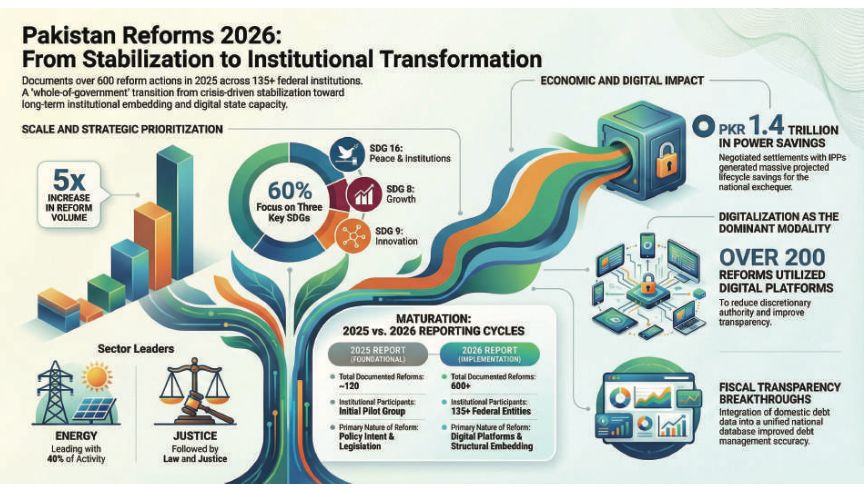
Mishal Pakistan, the Country Partner Institute of the World Economic Forum (WEF), today launched the Pakistan Reforms Report 2026, the second edition of the country’s first systematic documentation of governance reforms. While offering the most comprehensive snapshot to date of Pakistan’s evolving governance landscape, the report records over 600 reforms undertaken during 2025, covering 135 federal ministries, divisions, and attached institutions, marking a fivefold increase in reform volume compared to last year.
Report shows that the focus has shifted from crisis stabilization to long-term state capacity, with Energy leading at around 40% of total reform activity, followed by Law & Justice and Digital Governance and IT, reflecting a strong tilt toward structural and digital transformation. More than 200 reforms are now implemented through digital platforms, improving transparency and reducing discretion, while fiscal and energy sector measures are projected to deliver PKR 1.4 trillion in power-sector savings through renegotiated IPP contracts. Pakistan is unlocking indigenous energy and mineral resources through progress on the USD 6 billion Reko Diq copper-gold project and new tight gas and offshore exploration policies targeting USD 5 billion in investment.
Dr. Musadik Malik, Federal Minister for Climate Change and Environmental Coordination attended the launch as the Chief Guest, underscoring the government’s commitment to transparency, institutional strengthening, and evidence-based policymaking. Addressing the audience, the Minister emphasized “the importance of credible documentation in shaping Pakistan’s national narrative, noting that transparent, fact-based reporting of reforms strengthens public trust and enhances Pakistan’s credibility with international partners, investors, and development institutions.” He further said, “the Pakistan Reforms Report enables informed public discourse by shifting attention from announcements to execution and outcomes.”
The Pakistan Reforms Report 2026 is not a performance evaluation or political scorecard. Rather, it is a documentation exercise designed to help researchers, analysts, policymakers, investors, and international partners understand how governance systems are changing, how reforms are being institutionalized, and how these changes may shape citizens’ lives and state capacity over time.
Speaking at the launch, Amir Jahangir, Chief Executive Officer of Mishal Pakistan, said, “This report is about documenting governance change. By systematically capturing more than 600 reforms across 135 institutions, we are creating an institutional memory that allows Pakistan’s reform journey to be understood, compared, and analyzed over time.” He added that the 2026 edition reflects greater reform maturity, with a clear shift from announcements toward execution, digitization, and system-building.
Puruesh Chaudhary, Co-Founder and Director of Mishal Pakistan, highlighted the people-centric and institutional significance of the report, stating, “The Pakistan Reforms Report exists to help citizens, researchers, and future policymakers understand what is structurally changing in the state. Reforms matter when they improve access, transparency, and trust. This edition captures those shifts, particularly in digital governance, justice delivery, and citizen-facing services.”
A defining insight of the report is the strong concentration of reforms aligned with SDG-16 (Peace, Justice and Strong Institutions), signaling a deliberate shift toward institution-building as the core reform priority. A significant share of documented reforms focuses on rule of law, transparency, accountability, grievance redressal, regulatory modernization, digital justice, and public access to information, positioning SDG-16 not merely as a reporting category, but as a global indicator of Pakistan’s emphasis on strengthening institutional capacity as the foundation for sustainable economic and social development.
Importantly, the report situates these reforms within the challenging national context of 2025, marked by fiscal pressures, regional security dynamics, internal insurgencies, and geopolitical tensions. Despite these constraints, reform momentum remained intact, particularly in digitization, institutional coordination, and regulatory modernization.
By institutionalizing annual reform documentation, Mishal Pakistan aims to shift national discourse from episodic announcements to an evidence-based understanding of governance evolution, enabling year-on-year comparison and long-term reform tracking.
Mishal Pakistan is an award-winning institution specializing in business intelligence, public policy, governance benchmarking, and strategic communications. As the Country Partner Institute of the World Economic Forum, Mishal Pakistan contributes to leading global indices and policy frameworks related to competitiveness, governance, risk, gender parity, and digital transformation. Through data-driven research and policy advisory, the organization works with governments, international organizations, the private sector, and civil society to strengthen institutional capacity and document structural governance change.
The Pakistan Reforms Report forms part of Mishal Pakistan’s broader commitment to transparency, continuity, and global comparability in Pakistan’s reform journey.